Lawyers: timestamping case-file exhibits to secure the adversarial record
Files received from clients, successive versions of pleadings, exchanges with opposing counsel: a litigation file lives and changes. Electronic timestamping freezes each exhibit the moment it enters the file, and documents a chronology no one can rewrite.
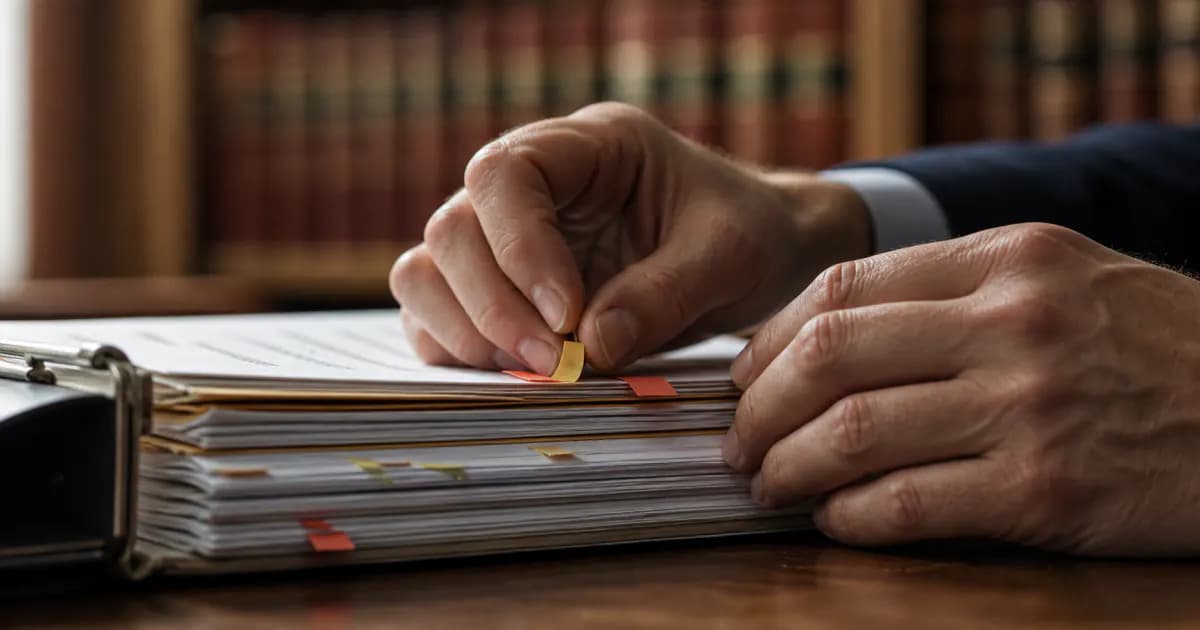
A client drops a USB stick at the firm: photos, exported emails, accounting files. Eighteen months later, at the hearing, opposing counsel suggests one of those exhibits was doctored along the way. Can the firm establish that the file produced is strictly the one received from the client, in the state it was received?
The integrity of exhibits runs through every dispute where digital evidence dominates, which now means almost all of them. This article looks at how electronic timestamping can fit into a firm's practice: what it freezes, what it does not prove, and where it complements (never replaces) the tools of procedure.
What exactly does a timestamp freeze in a litigation file?
An electronic timestamp binds a file's cryptographic fingerprint (SHA-256 hash) to a verifiable date. Applied to case exhibits, it establishes two facts: the exhibit existed in this exact form at this date, and it has not been modified since. It documents integrity and chronology, two frequent battlegrounds.
The framework is European: the eIDAS Regulation defines electronic timestamps and provides, in Article 41(1), that a timestamp cannot be denied legal effect solely because it is not qualified. A non-qualified timestamp (a blockchain anchor, for instance) must demonstrate its reliability to the court, which assesses it freely. Admissibility and probative weight remain two distinct questions.
Case law is taking shape: we analyzed the March 2025 Marseille judgment admitting a blockchain anchor as evidence of priority, and the 2026 Paris Court of Appeal decision on the evidence file behind an electronic signature, which stresses the technical file accompanying the process.
Where timestamping fits, and where it has no place
A useful clarification up front: procedural acts filed through court e-filing platforms are already timestamped by those systems, and that timestamp is what counts for deadlines. Independent timestamping adds nothing there.
Its ground is everything that lives upstream and alongside the procedure:
| Moment | What the timestamp freezes | Why it matters |
|---|---|---|
| Receiving client files | The exact state of the files handed over | Answering a later claim of tampering |
| Receiving documents off-platform | Content and date of what was exchanged | Documenting a disputed exchange |
| Successive versions of a draft | Each state of the working document | Tracing the drafting history |
| Internal capture (screenshot, export) | The state of content on the day of collection | Dating a collection before it disappears |
| Deliverables to clients (opinions, audits) | What was delivered, and when | Securing the firm-client relationship |
Adversarial-process rules across the EU require exhibits to be disclosed to the other side in due time. Timestamping obviously does not substitute for that official disclosure. It does let the firm document, on its side, the state of exhibits at each step of their circulation.
What it proves, what it does not
A timestamp proves a file's existence and integrity at a date. It proves neither who created it, nor who transmitted it, nor who received it. A cryptographic fingerprint identifies no one. The full chain, who handed over what, to whom, when, is built with other links: transmittal slips, delivery receipts, emails, signatures.
The distinction matters twice over for a lawyer, who may have to defend the process itself in court:
- Proven: this exhibit, in this exact binary version, existed at this date; it is identical today.
- Not proven: the identity of the author or depositor, receipt by a party, the lawfulness of how the exhibit was obtained, its weight on the merits.
A practical point follows: a timestamp works best paired with a contextual trace (a transmittal slip signed by the client, the transmission email) linking the dated fingerprint to an identified event. That pairing turns a technical fact into something usable in adversarial debate.
The independent-verifiability argument
Any evidence process produced by one party invites suspicion: "it is your tool, it says what you want." The answer lies in third-party verifiability.
An OpenTimestamps proof does not rest on the provider's word: the receipt contains a cryptographic path to a block of the Bitcoin blockchain, which anyone (opposing party, court expert, the bench) can check with open-source tools, no account or permission needed. We published a step-by-step independent verification tutorial, usable as is by an expert or a colleague.
This property changes the nature of the debate: the reliability of the process is not assessed on a vendor's reputation but on a public, checkable mechanism. It is an argument to press, and a requirement to hold against closed systems that do not offer it.
In practice: a file-intake reflex
The useful habit is simple: timestamp exhibits when they enter the file, not the day before the hearing. A late timestamp freezes the file's state on the day of the gesture: it does not travel back in time, and its chronological value suffers accordingly.
- 1On receiving client filesTimestamp the files handed over, and record the handover (slip, email). The dated fingerprint and the contextual trace are kept together.
- 2At every sensitive stepOff-platform documents from the other side, an export of online content, a settled version of a draft: each pivotal moment deserves its fingerprint.
- 3Archive receipts with the fileThe timestamp receipt joins the sub-folder of the exhibit it covers. If challenged, the exhibit + receipt pair is produced immediately, with the verification tutorial.
On long-term retention (litigation drags on), our guide to archiving digital evidence over 10 years covers formats and precautions.
Where does LegalStamp fit in?
LegalStamp is a non-qualified electronic timestamp under eIDAS. For a firm, two characteristics matter most. Confidentiality first: the SHA-256 hash is computed locally in the browser, the exhibit never leaves the firm's workstation. Only the fingerprint, which reveals nothing of the content, is anchored on the Bitcoin blockchain. Compatible, therefore, with professional privilege. Verifiability second: the receipt relies on OpenTimestamps, an open-source protocol, checkable by an expert without depending on LegalStamp, even if the service were to disappear.
The limits are stated plainly: no presumption of accuracy (that is reserved for qualified timestamps), no proof of identity, no substitute for official procedural channels. For matters requiring a qualified timestamp, providers on the EU Trusted Lists are the right counterparts.
The free plan timestamps 3 exhibits a month, no credit card, enough to test the habit on a real file before rolling it out. Try it free →
Conclusion
Exhibit integrity and chronology are classic angles of attack in digital litigation. Electronic timestamping answers with a dated technical fact, independently verifiable, at a cost compatible with systematic use from file intake. It replaces neither procedural timestamps, nor adversarial disclosure, nor the court's assessment: it adds to the file a layer of dated facts that the parties' memories cannot rewrite.
Disclaimer: this article is provided for informational and educational purposes. It does not constitute legal advice. For a specific case (dispute, compliance, proceedings), have your evidence strategy validated by a legal professional.