Architects: Protecting Plans, Studies and Project Deliverables Before Sharing Them
Competitions, tenders, subcontracting: your plans circulate before any contract is signed. How copyright protects architectural works, and how to timestamp every version to document priority.
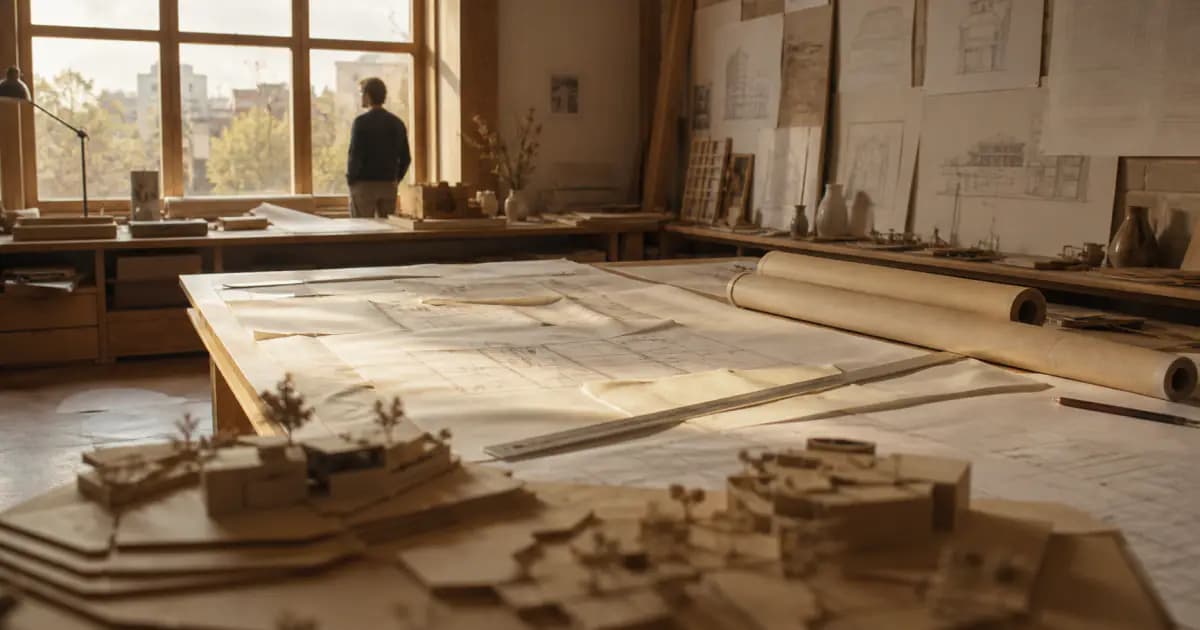
An architecture firm submits its entry to a competition for a media library: sketches, site plan, sections, design statement. It is not selected. Eighteen months later, the winning project as built shows a massing and a facade treatment strikingly close to its boards. The firm is convinced its work was borrowed. But what can it actually demonstrate, documents in hand, about what it had designed, and when?
There is nothing unusual about this scenario. Architecture is a profession that requires showing your work before being paid for it: competitions, tenders, business development, subcontracting. Every handover of plans is a moment of exposure. This article looks at what copyright actually protects in architecture, at the situations where the risk is highest, and at one simple habit: dating every version before you share it.
Note on scope: the detailed legal references below are French, but the underlying principle holds across the EU: copyright in works of architecture exists throughout the Union under the Berne Convention and the harmonised copyright framework, including Directive 2001/29/EC (InfoSoc). The evidential questions are similar everywhere; the specific rules of your jurisdiction may differ.
Are architectural plans protected by copyright?
Yes, provided the work is original. The Berne Convention lists works of architecture and related plans and sketches among protected works, and French law names them expressly: Article L.112-2 of the Intellectual Property Code covers works of architecture and plans, sketches and three-dimensional works relating to architecture. Protection arises from creation, without registration, but requires originality, which the court assesses.
Article L.112-2 of the French Intellectual Property Code lists among protected works of the mind, in particular:
- at 7°: works of drawing, painting, architecture, sculpture, engraving and lithography;
- at 12°: plans, sketches and three-dimensional works relating to geography, topography, architecture and science.
Both the building and its graphic representations fall within the scope of copyright. And Article L.111-1 states that the author enjoys these rights "by the mere fact of its creation": no filing or registration is required for the right to exist. Most EU member states follow the same logic, rooted in the Berne Convention, which includes "works of architecture" and "plans, sketches and three-dimensional works relative to architecture" among protected works.
Two important caveats, often overlooked.
Protection requires originality. Copyright does not protect a plan because it is a plan, but because it bears the imprint of its author's creative choices. Originality is assessed by the court, case by case. Purely technical or functional solutions (dimensions imposed by regulations, a standard structural grid, a layout dictated by site constraints) are not, in themselves, protected by copyright.
The right exists, but you still have to prove your case. In a conflict, the question is almost never "does copyright apply to architecture?" but "who designed what, and when?". That is a problem of evidence, not of principle. And this is exactly where dating your documents comes in.
When are your plans most exposed?
An architect's plans circulate mostly upstream of any contract: competitions, tenders, business development, subcontracting. It is in these phases, where work is handed over without any firm commitment from the recipient, that the risk of reuse is highest, and that the ability to date your versions matters most.
Architecture competitions
A competition asks for the core of your added value (design concept, massing, integration, sketches) in exchange for a chance of being selected, sometimes a fee. Your boards pass through the hands of a jury, a client, project management consultants. If a later project picks up your design choices, your position will depend on what you can establish about the state of your design at the submission date.
Tenders and public procurement
In public procurement, submitting a technical memorandum, studies or plans takes place within a contractual framework: standard terms such as the French CCAG contain intellectual property clauses that organise the assignment or licensing of rights over deliverables. What you assign, to whom and for which uses is a matter for the contract, not for a blog post. What remains useful in every scenario is being able to demonstrate precisely what you delivered, in what state and at what date: a dispute over the scope of an assignment, reuse outside the agreed perimeter, or an unsuccessful bid whose ideas resurface.
The intellectual property clauses of the applicable standard terms and of your contract determine who may use your deliverables and how. A timestamp changes none of that: it documents a date and a content, nothing more. To interpret an assignment of rights, seek advice from a legal professional.
Subcontracting and co-contracting with engineering firms
Between a lead architect and structural, MEP or environmental engineers, files are exchanged continuously: plans, models, calculation notes, detail drawings. When the collaboration turns sour, or when each party claims authorship of a design solution, the chronology of exchanges becomes the central element. Who produced this detail, in which version, before which transmission?
Business development and preliminary studies
The feasibility study offered to a developer, the sketch sent to convince a private client: finished documents handed over with no signed contract. If the project then goes ahead without you, on foundations close to your proposal, your case will rest on what you can date.
| Sharing situation | What circulates | Main risk | Dating reflex |
|---|---|---|---|
| Competition | Sketches, site plan, statement | Design concept picked up elsewhere | Timestamp the full set before submission |
| Tender / public procurement | Memorandum, studies, plans | Dispute over the scope of use of deliverables | Timestamp each deliverable at handover |
| Subcontracting / engineering | Plans, details, calculation notes | Contested authorship of a solution | Timestamp each version exchanged |
| Business development | Feasibility, sketches | Project built without you on your basis | Timestamp before any transmission |
| Internal design work | Successive versions | Unverifiable design chronology | Timestamp milestones (concept, preliminary, detailed design) |
How do you date each version of your plans before sharing them?
The principle: before each handover, freeze a digital fingerprint of the document set and timestamp it. For each version, you obtain verifiable evidence that these exact files existed at that date, unaltered. Repeated at every milestone, the operation builds a design chronology that strengthens a body of evidence of priority.
In practice, an electronic timestamp relies on the file's SHA-256 fingerprint: a unique string computed from the exact content of the document. Change one line on the plan and the fingerprint changes. Anchoring that fingerprint to a date (for instance in the Bitcoin blockchain via the open-source OpenTimestamps protocol) seals the pair "this content / this date" in a way anyone can verify.
Here is a workflow suited to a firm, aligned with project phases:
- 1Export the document set to be frozenPDF boards, DWG files, IFC model, design statement: gather the files exactly as they will be delivered (jury, client, engineers). That is the version to date — not a working copy.
- 2Timestamp the batch before handoverCompute and anchor the fingerprint of each file — batch timestamping handles a complete set of drawings in one operation. Blockchain anchoring is deferred by a few hours: start it before sending, not after.
- 3Archive the receipts with the projectKeep the .ots receipts and the original files in the project folder (plus a separate backup). A receipt is useless without the exact file it corresponds to.
- 4Repeat at every milestone and every new versionConcept, preliminary, detailed design, construction documents: every shared version deserves its date. The series of successive timestamps documents the progression of your design — more telling than a single date.
- 5In a dispute, produce the chronologyFiles, timestamp receipts and proof of transmission (emails, submission receipts) together form the body of evidence your counsel can build on.
One point specific to the profession: your plans are confidential before a tender. A workflow where the fingerprint is computed locally, without transmitting the file, avoids routing sensitive documents through a third-party server: the document never leaves your machine, only its fingerprint is anchored.
What a timestamp proves, and what it does not
A timestamp proves that a given file existed at a given date and has not been modified since (existence, integrity, priority). It proves neither who created the work, nor who owns the rights, nor that the work is original. It is one serious piece of evidence in a file, not a title of ownership.
What a timestamp establishes:
- Existence: this file existed at the time of anchoring.
- Integrity: the file produced today is identical, bit for bit, to the one timestamped.
- Priority: its date is independently verifiable, and earlier than the disputed facts.
What it does not establish:
- Identity: a fingerprint does not say who created the plan, nor who performed the timestamp on whose behalf.
- Ownership: holding a timestamped file does not make you the rights holder; in procurement, the contract settles that question.
- Originality: the condition for copyright protection, which remains for the court to assess.
In other words, a timestamp does not "protect" your plans in the sense of creating a right: copyright arises from creation. It documents the priority of your work, which, in practice, is usually where disputes are won or lost.
On admissibility: the eIDAS Regulation (Article 41.1) provides that an electronic timestamp shall not be denied legal effect and admissibility as evidence in legal proceedings solely on the grounds that it is in electronic form or does not meet the requirements of a qualified electronic timestamp. A non-qualified timestamp can therefore be admissible; its evidential weight is assessed by the court, case by case, alongside the other evidence.
Where does LegalStamp fit in?
LegalStamp is a non-qualified electronic timestamping service designed for exactly this workflow. The SHA-256 fingerprint of your files is computed directly in your browser: the plan, model or study never leaves your machine, only the fingerprint is transmitted, which matters when documents are confidential before a bid. The fingerprint is then anchored in the Bitcoin blockchain via OpenTimestamps; anchoring is deferred by a few hours, and you receive a .ots receipt that can be verified independently, even without LegalStamp. Batch timestamping lets you freeze a complete set of drawings (boards, DWG files, statement) in a single operation before each milestone.
Let us be clear about the limits: LegalStamp is not a qualified trust service provider under eIDAS, does not store your files, and a timestamp replaces neither a contractually organised deposit nor the advice of a lawyer. If your situation requires a qualified timestamp, turn to a provider on the EU Trusted Lists.
The free plan includes 3 timestamps per month, no credit card required, enough to test the workflow on a real milestone. Paid plans start at €9/month for 200 timestamps, a volume suited to a firm's versioning rhythm. For the technical details, see how it works.
Freeze every version of your deliverables before sharing them, starting at €0. See LegalStamp pricing →
Conclusion
Your plans and studies are protected by copyright from the moment of creation, provided they are original, but in practice that right is only worth what you can prove. Competitions, tenders, subcontracting and business development are all moments when your work circulates before any commitment. Timestamping each version before sharing it takes a few minutes and builds, milestone after milestone, a verifiable design chronology: serious evidence for the day the priority of your work is challenged.
Disclaimer: this article is provided for informational and educational purposes only. It does not constitute legal advice. For a specific situation (dispute, compliance, proceedings), have your evidence strategy reviewed by a legal professional.