France's CSPLA Report on AI-Assisted Works: What Copyright Protects, and How to Document the Human Part
On 16 July 2026, France's CSPLA, an advisory council on literary and artistic property, published its report on the status of AI productions. Its line: no need to reinvent copyright, an AI-assisted work remains protectable if a human keeps creative direction. But demonstrating that input is an evidence problem, and the report details the tools to address it: creation files, intermediate versions, prompt logs. Here is what it says.
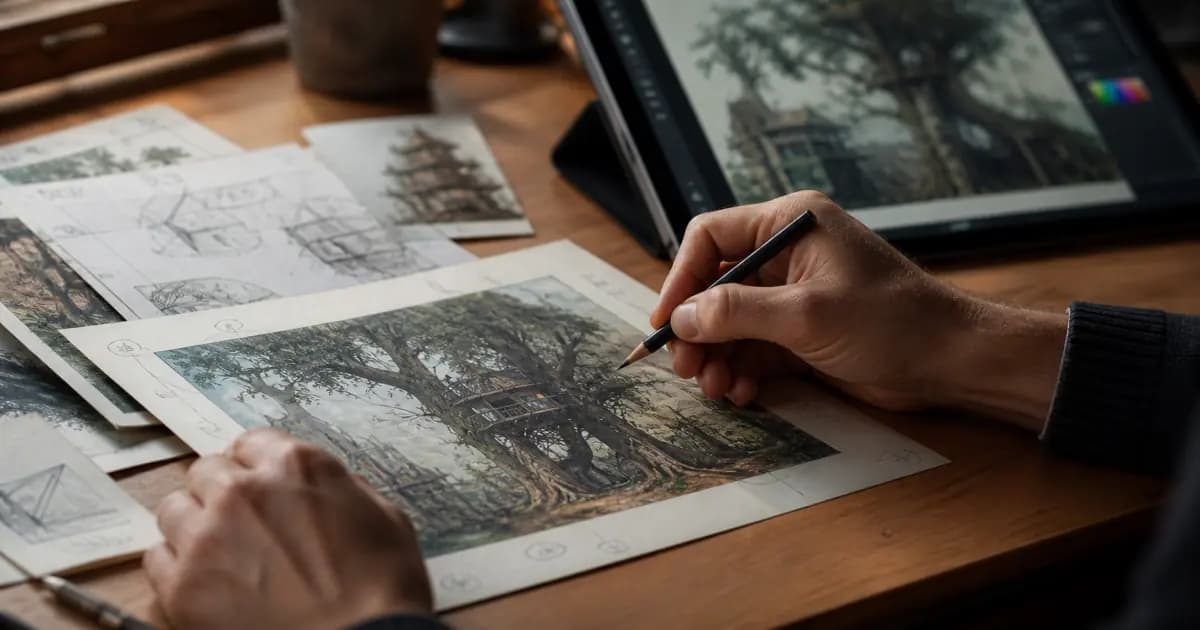
An illustrator is building the visual universe of a video game. She sketches her characters by hand, generates background variants with an image model, discards dozens of them, retouches the ones she keeps, adjusts the palettes, and assembles everything into her final boards. Six months of work. The studio receiving the portfolio asks a question that has become routine: "Which part is yours, and can you demonstrate it?"
That question is precisely what France's Conseil supérieur de la propriété littéraire et artistique (CSPLA), an advisory council on literary and artistic property attached to the Ministry of Culture, has just addressed in a 130-page report. Its answer comes in two movements: copyright does not need to be reinvented to accommodate AI-assisted creations, but their protection now plays out on the field of evidence. Here is what the report says, and the practical reflexes to draw from it.
What does the CSPLA report of 16 July 2026 say?
The mission report on the status of artificial intelligence productions, chaired by Alexandra Bensamoun (rapporteur: Julie Groffe-Charrier), was presented at the CSPLA plenary session of 9 July 2026 and published on 16 July 2026. It concludes that originality, as defined by European case law, is enough to assess AI-assisted creations, without any redefinition.
The CSPLA advises France's Minister of Culture on literary and artistic property. Its report is reference doctrine whose content, as it states itself, binds only its authors. It creates no new rule: it clarifies how existing law applies, and its prospective ideas (such as a paying public domain) remain working hypotheses that have not been adopted.
The report rests on a founding distinction between two categories of AI-related content:
- hybrid production: a human keeps an active role in the creative process. When it crosses the originality threshold, it becomes a hybrid creation, protectable by copyright like any other work;
- synthetic production: generated without significant human intervention, it remains outside copyright and, according to the report, belongs to the public domain.
On the originality standard, the position is clear-cut: no specific threshold can be imposed on hybrid productions merely because the tool used is an AI. The report relies in particular on the Mio/Konektra ruling of the Court of Justice of the European Union (4 December 2025) and on its first French application, Evema v Someva (9 April 2026), which holds that the creative character of choices is never presumed.
The report is the third act of a busy 2026 sequence in France: after the French Senate bill creating a presumption that AI providers used protected works, then the entry into application of the AI Act's transparency obligations, French doctrine now clarifies the status of what comes out of the machines.
Is a work created with AI protected by copyright?
Yes, if it bears the trace of human creative choices. The report identifies three moments where originality can reside: upstream (conception, settings, a detailed prompt), during generation (iteration and direction of the tool), downstream (selection, editing, integration). A single one of these "seats" is enough, provided it shows in the result.
The dividing line proposed by the report comes down to one alternative: at each stage, did the user exercise creative direction whose trace is imprinted in the result, or did they delegate to the machine the decisive expressive choices? Delegation shows through concrete signs: generic instructions, re-runs without creative inflection, adoption of the raw output.
The table below summarizes this logic, bearing in mind that in every case the assessment of originality remains within the court's sovereign discretion.
| Level of AI assistance | Likely protection under current law | What you should be able to document |
|---|---|---|
| AI as an occasional tool (correction, cleanup, enhancement) on a human creation | Protection of the human work unchanged | The source files predating the tool |
| Directed hybrid creation: detailed conception, iterations with inflections, substantial selection and editing | Protectable if human creative choices remain visible in the work | The version timeline, non-AI drafts, the choices made at each stage |
| Generic prompt followed by adoption of the raw output | Protection unlikely: signs of delegation to the machine | Little to document, for lack of identifiable creative input |
| Purely synthetic production, without significant human intervention | No protection: public domain according to the report | Not applicable |
Two cross-cutting safeguards complete the report's assessment grid. First, claimed input that does not show in the work itself is inoperative: the law looks for the trace in the object, not for a mere narrative of process. Second, if any user, with equally generic instructions, would obtain an undifferentiated result, the personal imprint is missing.
Proving human input: the evidentiary challenge identified by the report
The report states it plainly: a hybrid creation is a work like any other, and the difficulty lies not in its legal regime but in its demonstration. AI deprives human creation of the self-evidence it used to enjoy. Authorship is presumed (Article L. 113-1 of the French Intellectual Property Code), but originality is never presumed.
The burden of proof is then distributed in two steps, without changing existing law:
- First step: the initiative lies with whoever challenges protection. They must put forward concrete indications of generation without decisive human intervention. As long as originality is not challenged, the creator has nothing to establish.
- Second step: once such indications are produced, the burden shifts. The claimant must establish that the expressive choices visible in the work stem from their creative activity, not from the mere operation of the system.
German courts have already reasoned along these lines, the report notes: the Frankfurt regional court (December 2025) dismissed a challenge based on abstract probability alone, and the Düsseldorf court of appeal (April 2026) denied protection to a claimant who remained silent about their creative choices. A challenge fails when it stops at probability; a claim fails when it declines to document the process.
What tools serve this demonstration? The report lists them, recalling that the work itself comes first and that process evidence only plays a supporting role: the creation file (intermediate versions, drafts and originals not generated by AI), metadata, the prompt log, declarations made to trusted third parties, and indications drawn from transparency regimes such as AI content labeling under Article 50 of the AI Act. None of these tools is necessary or sufficient, and the report insists on the point: marking attests to the artificial origin of content, not to human input.
One last safeguard deserves emphasis. The report warns against letting these evidentiary requirements harden into a de facto formality conditioning the existence of the right, which the Berne Convention prohibits. Documenting your process is not an obligation: it is a precaution for the day doubt is raised before a court.
How do you document your creation timeline as you work?
In practical terms, the takeaway for a creator working with AI is to build the creation file during the work, not after it. A documented, dated genesis provides the material for the second step of the evidentiary mechanism. Here is a simple workflow.
- 1Keep your non-AI building blocksSketches, intent notes, moodboards, scanned handwritten drafts, source files: these elements, created before or outside the machine, are the most telling indications of human creative direction.
- 2Record your instructions and your choicesPrompt log, settings, reasons for rejecting or reworking an output: note what you decided at each iteration. That is the difference between creative direction and a mere re-run.
- 3Save each successive version, including the final fileExport intermediate states of your work: first composition, discarded variants, major edits. A series shows a progression, where a single file only shows a result.
- 4Date each version at the moment it existsTimestamp each intermediate state as you go, for instance through a SHA-256 fingerprint anchored on a blockchain. A timeline dated in real time carries more weight than a reconstruction after the fact.
- 5Archive everything consistentlyGroup files, timestamp receipts and your logbook in one folder per project. The day your input is challenged, you can unfold a complete genesis instead of hunting for fragments.
What a timestamp proves, and what it does not prove
Let us be precise, because the nuance is exactly the one the report makes about evidentiary tools: none is sufficient on its own.
An electronic timestamp proves that a specific file, identified by its fingerprint, existed at a given date and has not been modified since (integrity). A series of timestamps on successive versions establishes a timeline: this draft existed before that variant, which existed before the final file.
A timestamp does not prove who created the file (identity), nor that you own the rights, nor, above all, which share of the creation is human. A file generated in one click can be timestamped just as easily as a laboured draft. It is the series of dated versions, consistent with your drafts and your creation log, that amounts to a serious indication of a creative process spread over time. It strengthens a body of evidence that the court will weigh at its discretion; on its own, it does not demonstrate originality.
Where does LegalStamp fit in?
LegalStamp is a non-qualified electronic timestamping service within the meaning of the eIDAS Regulation. The principle: the SHA-256 fingerprint of your file is computed in your browser, the file never leaves your device, only the fingerprint is transmitted. It is then anchored on the Bitcoin blockchain through the open OpenTimestamps protocol (the Bitcoin attestation is deferred until a block confirmation), and you receive a .ots receipt that can be verified independently, even without going through LegalStamp. The mechanics are detailed on our how-it-works page.
For the workflow described above, the tool fits naturally: at each milestone of your creation, you timestamp the state of the file, and the series of receipts documents your timeline. Two limits to keep in mind. A non-qualified timestamp does not enjoy the presumption attached to qualified ones, even though Article 41.1 of the eIDAS Regulation prohibits denying an electronic timestamp legal effect as evidence solely because it is not qualified. And as the CSPLA report recalls for every traceability tool, timestamping plays a supporting role: it is your work, visible in the piece itself, that grounds originality, not the receipt that dates it.
The free plan lets you timestamp 3 files per month, with no credit card: enough to date the key stages of an ongoing project. Try it free (3 timestamps/month, no card required) →
Key takeaways
The CSPLA report of 16 July 2026 confirms that an AI-assisted work remains protectable by copyright in France as long as a human keeps creative direction and that direction can be read in the result. It moves the real issue to evidence: when a challenge is substantiated, it falls to the creator to establish that the expressive choices stem from their own creative activity. A creation file dated as you go (drafts, iterations, successive versions) prepares that demonstration far better than a late reconstruction. Timestamping is one of the tools of that traceability: useful for dating, never sufficient for qualifying.
Disclaimer: this article is provided for informational and educational purposes only. It does not constitute legal advice. For a specific situation (dispute, compliance, proceedings), have your evidence strategy validated by a legal professional.

Related articles
SecNumCloud Made Mandatory by the August 2026 Order: What France's SREN Law Changes for Cloud Trust — and What It Does Not Prove
August 26, 2026

Mandatory AI Content Labeling (AI Act Article 50): How to Show a Work Is Human-Made and Prior?
August 24, 2026
The EDPB wants AI training data to be timestamped: what the draft guidelines say
July 17, 2026