CJEU Pelham II ruling: why dating your versions becomes strategic in sampling and remix cases
On 14 April 2026, the Court of Justice of the European Union clarified the scope of the pastiche exception in the Pelham II case. Practical consequences for proving the chronology of your derivative creations.
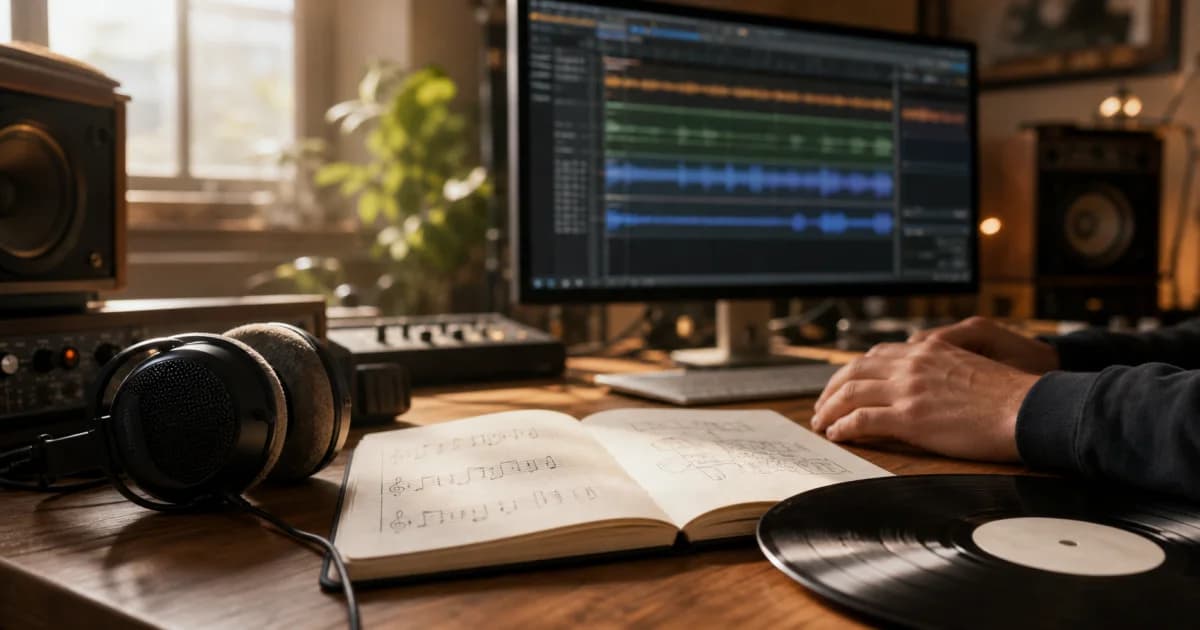
On 14 April 2026, the Court of Justice of the European Union delivered its ruling in Pelham II (C-590/23), a case that has been bouncing through German courts for almost three decades. The dispute originated with a two-second sample lifted from Kraftwerk's Metall auf Metall and looped throughout the Moses Pelham track Nur Mir.
Beyond the music, this ruling is the first to give binding European scope to the notion of pastiche. For creators who produce derivative works — samplers, remixers, video essayists, parodists, transformative illustrators — the decision changes how a defence file should be assembled in litigation. And at the heart of that strategy: the demonstrable chronology of versions.
What the ruling says, in brief
The CJEU clarifies the scope of the pastiche exception set out in Article 5(3)(k) of the InfoSoc Directive 2001/29. To benefit from this exception, a use must:
- enter into an identifiable artistic or creative dialogue with the earlier work or its author,
- have an objectively identifiable purpose (pastiche is not a label slapped on after the fact),
- remain distinct from parody and caricature, which are separate exceptions with their own criteria.
The European message is clear: pastiche is not a free pass to reuse a protected work. It is a targeted exception, justified by a demonstrable creative intent.
The full press release from the CJEU is available on the Court's official site. The full ruling is referenced under C-590/23.
Why this ruling puts chronology back at the centre
When a judge assesses whether a use qualifies as pastiche, several facts must be reconstructed:
- When was the source work created and published? That is the baseline: no priority, no possible pastiche.
- When was the derivative work produced? Not a trivial detail — the date conditions which exact version of the source work could have been consulted.
- What transformations were applied, and when? The successive production stages (sketches, intermediate mixes, stems, DAW project files) tell the story of creative intent.
Without a reliable chronology, the analysis becomes a fragile exercise in reconstruction, where each side asserts dates that nobody can objectively verify any longer.
A concrete example: musical sampling
Picture a producer who samples two seconds of a track released in 1977. Thirty years later, the rights holder sues. The producer invokes pastiche: their track is meant to enter into dialogue with the electronic aesthetic of the 1970s.
To support this defence, they must demonstrate:
- the writing date of their derivative track (sketches, demos, recording sessions),
- the state of the music market when the work was created (other reference works, stylistic context),
- the chain of creative decisions that led to choosing this exact sample over another.
Without dated artefacts, the argument rests on their word. With a file that contains timestamped session exports (a DAW export at a specific date, an intermediate mix anchored on a blockchain), the defence becomes substantially more solid.
What about other transformative creators?
The ruling speaks of music, but the European logic of pastiche applies to all transformative uses of protected works:
- Video creators who reuse excerpts in essay videos
- Illustrators who rework familiar iconography
- Parodists and meme creators who transform a source image
- Authors who pastiche an identifiable literary style
- Designers who draw on an earlier visual identity
In all these cases, the qualification depends on demonstrable intent and creative dialogue. And dating the intermediate steps has become a central piece of evidence.
What it proves, what it does not
Electronic timestamping locks the date of existence of a file. It does not, on its own, determine whether your use qualifies as pastiche, parody, caricature or infringement. Legal qualification remains the judge's call, based on content and intent.
In practice, a well-built defence file combines:
- timestamped artefacts (successive versions, DAW exports, project files, drafts)
- contextual elements (exchanges with collaborators, commissions, cited references)
- an artistic demonstration (statement of intent, comparative analysis, stylistic framing)
Timestamping is just one brick. But without that brick, the other pieces lose probative weight: it is hard to defend a creative chronology when you cannot prove that the file produced as an "intermediate version" actually existed before the lawsuit.
What LegalStamp brings here
For a creator regularly working on transformative works, timestamping each intermediate version becomes a piece of professional hygiene. LegalStamp computes the SHA-256 hash of a file (a mix, a stem, an export, a draft) directly in the browser — the file never leaves your machine — then anchors that hash on the Bitcoin blockchain via OpenTimestamps.
The result: a cryptographic proof, independently verifiable, attesting that this exact file existed at a given date. In a sampling, parody or pastiche dispute, you can produce this chain of timestamped versions as evidence of your creative process.
LegalStamp is a non-qualified timestamping service under eIDAS. That means the timestamp does not benefit from the presumption of reliability reserved for qualified trust service providers (QTSPs). However, Article 41(1) of the eIDAS Regulation prohibits courts from rejecting an electronic timestamp solely because it is not qualified. Combined with other evidence, it carries real probative weight.
LegalStamp's free tier offers 3 timestamps per month, no credit card or complex signup required. Enough to test the workflow on your first files and see how to fold this routine into your creative process. Try it for free →
Conclusion
The Pelham II ruling of 14 April 2026 does not revolutionise European copyright law, but it sharpens it on a point that has become crucial in the era of transformative works. Pastiche exists as an exception, but it requires demonstration: creative intent, artistic dialogue, distinction from mere reuse.
That demonstration rests on artefacts only the creator can produce — and only if they were assembled before litigation. Timestamping intermediate versions, preserving exchanges, documenting intent: these reflexes cost almost nothing to set up and can make the difference in a contentious file.
FAQ
Disclaimer: this article is provided for informational and educational purposes only. It does not constitute legal advice. For a concrete case (sampling dispute, infringement defence, deposit strategy), have your approach validated by an attorney specialised in intellectual property law.

Related articles

France's CSPLA Report on AI-Assisted Works: What Copyright Protects, and How to Document the Human Part
August 28, 2026
SecNumCloud Made Mandatory by the August 2026 Order: What France's SREN Law Changes for Cloud Trust — and What It Does Not Prove
August 26, 2026
Mandatory AI Content Labeling (AI Act Article 50): How to Show a Work Is Human-Made and Prior?
August 24, 2026