Blockchain Timestamping vs NFT: Which Tool Actually Protects a Creation?
NFTs and blockchain timestamping are often confused. Yet their goals, legal weight and use cases differ deeply. A clear comparison to help creators choose the right tool.
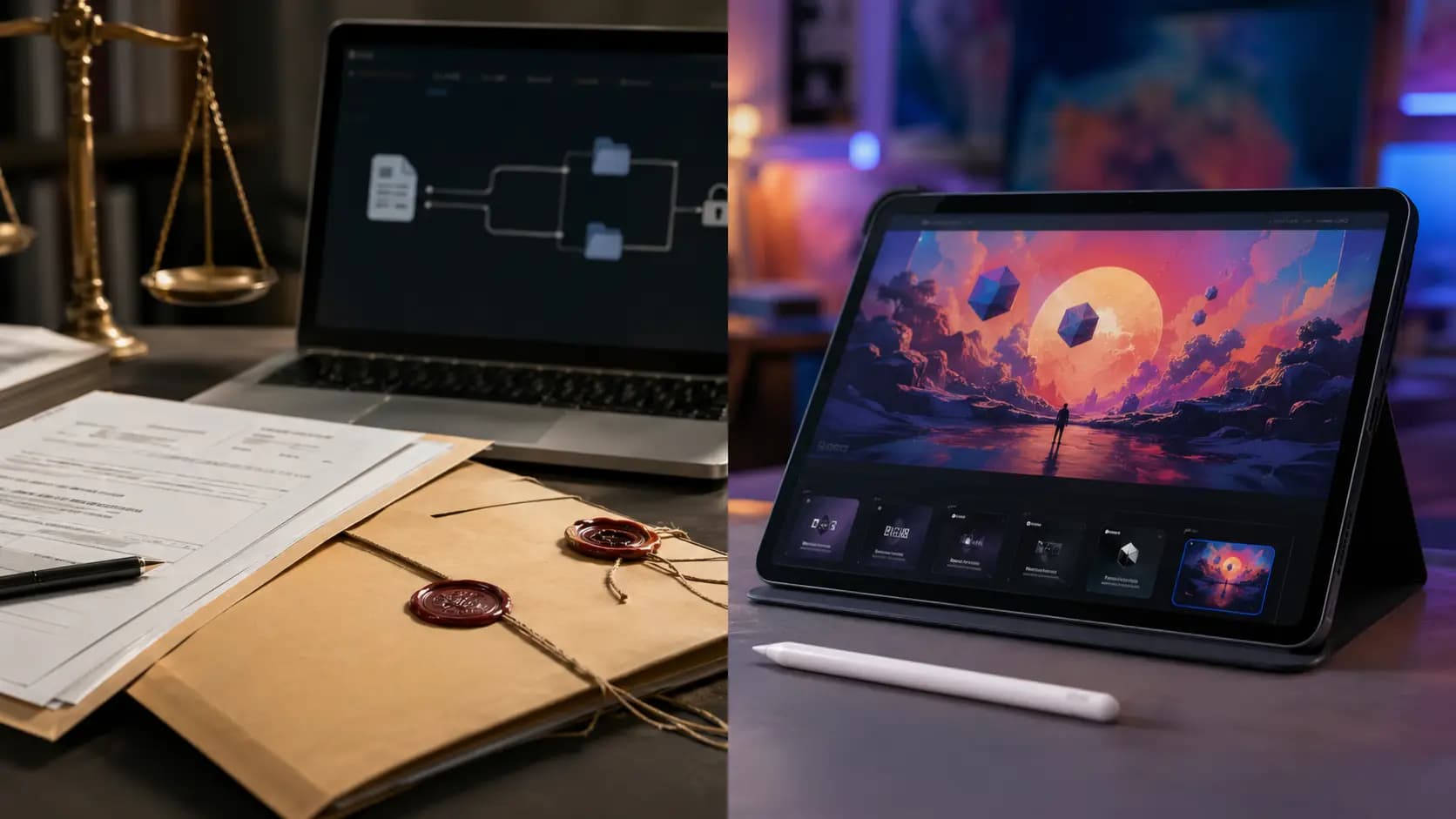
A question keeps coming up: "If I mint my work as an NFT, it's protected, right?" The answer is more nuanced — and often disappointing for creators who thought minting alone would secure their rights.
NFTs and blockchain timestamping rely on the same underlying technology (a distributed ledger), but they serve completely different purposes. One creates a transferable token tied to a digital asset. The other provides proof of existence and integrity of a file at a given moment.
An NFT is not an authorship certificate. A timestamp is not a property title. Confusing the two can lead to serious legal misunderstandings.
Both tools in one sentence
Blockchain timestamping: you inscribe the cryptographic fingerprint (hash) of a file onto a blockchain at time T. Later, you can prove that this exact file existed by that date.
NFT (Non-Fungible Token): you mint a unique token on a blockchain, containing metadata (typically a link to a file or image hosted elsewhere). The token can be transferred, sold, and identifies a "holder" at any moment.
Timestamping is the date stamp a city hall puts on your file. An NFT is more like a transferable property title — except no one verifies that the holder was actually the creator of the underlying content at mint time.
Comparison table
| Criterion | Blockchain timestamping | NFT |
|---|---|---|
| Main purpose | Prove a file existed at a date | Tokenize a transferable digital asset |
| What is recorded | File hash (fingerprint) | Metadata + URI to the file |
| Confidentiality | Yes (hash reveals nothing) | No (metadata is public) |
| Authorship verification | Helps prove prior existence | No author verification at mint |
| Typical cost | Free (OTS) to a few € (qualified) | A few € to dozens depending on chain |
| Legal recognition | Growing (eIDAS, French case law 2025) | No dedicated framework |
| GDPR compatibility | Strong (hash only) | Risky if personal data |
| Typical use | Prior art, integrity, audit | Collectibles, digital art, royalties, community |
What an NFT actually proves
When you mint an NFT, you create a public record stating: "On this date, blockchain address X minted a token pointing to this content." That's it.
What it does not prove:
- That you authored the underlying content.
- That you hold copyright on that content.
- That no one created the same content before you.
The Hermès vs MetaBirkins ruling (US District Court, February 2023) confirmed that an NFT confers no license over a represented trademark or work: Mason Rothschild was found liable for infringement despite the NFTs existing on-chain. The European Union Intellectual Property Office (EUIPO) report on NFTs and IP (2024) similarly emphasizes that minting an NFT neither creates nor automatically transfers any IP rights.
A bad actor can download an artwork available online, mint it as an NFT on OpenSea or any equivalent marketplace within minutes. The token will exist — but will not give any legitimate right to the original work.
What timestamping actually proves
Timestamping answers a precise question: "Did this file exist at this date, in this exact state?"
What it demonstrates:
- Prior existence: the file (or its content) existed by the anchoring date at the latest.
- Integrity: the file presented today is identical to the timestamped one (if the recomputed hash matches).
What it does not demonstrate:
- The author's identity (unless paired with an electronic signature).
- The originality of the work (a substantive question, decided by judges).
The French Decree No. 2024-139 (February 20, 2024) clarified the conditions under which an electronic timestamp can serve as preliminary evidence. Case law is evolving too: the Tribunal judiciaire de Marseille accepted blockchain anchoring as evidence in a copyright dispute in March 2025.
When to choose timestamping
Timestamping is the go-to tool whenever you want to lock in a discreet, solid proof without exposing the content:
- 1Deliverables and contractsProve that a deliverable, specification or contract version existed at a given date — without revealing its confidential content.
- 2Work-in-progress creationsTimestamp drafts, sketches, intermediate versions of a work before publishing it.
- 3Source code and technical IPProve prior art for a module, algorithm or architecture — useful for freelancers, IT service firms and startups.
- 4Photos and reportageTimestamp RAW files before publication to document the chronology of capture and editing.
- 5Administrative or pre-litigation filesBuild a dated, opposable proof of state (reports, exchanges, observations).
When to choose an NFT
NFTs make sense in contexts of digital marketplace, community and programmability:
- Limited editions sales: an artist tracking ownership of a 100-piece digital edition.
- Automatic royalties: programming a percentage on each resale on compatible marketplaces (ERC-2981).
- Gated access: using the NFT as a key to a community, a drop, or an event.
- Native digital art provenance: works specifically designed to live on-chain.
A well-designed NFT can complement a protection strategy, but it should never be the cornerstone of prior-art evidence. It is a distribution and market channel, not an evidentiary framework.
Combining both: the hybrid strategy
For creators who want to both protect and monetize a digital work, combining the two makes sense.
Typical workflow:
- You finalize your work (high-resolution source file).
- You timestamp the source file via a solution like LegalStamp or OpenTimestamps.
- You keep the original file and the timestamp proof off-chain.
- You mint an NFT whose metadata can reference the timestamp proof (URI or hash).
- You distribute the work, sell the NFT, and retain the full chain of custody: you can prove both the creation predating the mint and the chain of transfers.
This approach is notably recommended by the French CSPLA report on NFTs and the art market (2022), which highlights the importance of decoupling proof of creation from proof of transaction.
Cost and accessibility
| Solution | Indicative cost | Accessibility |
|---|---|---|
| OpenTimestamps (Bitcoin anchoring) | Free | CLI tools, integrations |
| eIDAS qualified timestamping (QTSP) | €0.01 to a few € | Through certified provider |
| LegalStamp (full workflow) | Plan-based | Web UI, API |
| NFT on Ethereum L1 | Variable gas (often €5-50) | Wallet + marketplace |
| NFT on L2 (Polygon, Base, Arbitrum) | Often < €1 | Wallet + marketplace |
Common mistakes to avoid
Believing an NFT equals an IP title → Copyright is not granted by a blockchain. It exists from the original creation and can be proven by any means.
Tokenizing a work you don't own rights to → Risk of infringement (cf. MetaBirkins ruling). Minting clears no rights.
Inscribing personal data in an NFT → Potential GDPR conflict (right to erasure vs immutability). Prefer hash-based timestamping.
Relying solely on IPFS hosting for an NFT → If the pin drops, the content disappears. Always keep a local copy of the source file.
Mixing prior-art proof and signature → A timestamp dates a file; an electronic signature commits a party. Two complementary, distinct mechanisms.
FAQ
Conclusion
NFTs and blockchain timestamping are not competitors: they are two different tools answering two different questions. NFTs answer "who holds this token?". Timestamping answers "did this file exist at this date?".
For protection of a creation, timestamping remains the reference: confidential, low-cost, legally solid, and GDPR-compatible. NFTs find their relevance in digital marketplace strategies, where ownership traceability and programmable royalties bring real value.
Our recommendation: timestamp first, mint later (if relevant at all). Timestamping takes 30 seconds and forms the evidentiary foundation; the NFT is a distribution channel you can always layer on top.
LegalStamp timestamps your creations in a few clicks, with blockchain anchoring, eIDAS legal presumption, archiving and GDPR compliance included. No CLI, no wallet, no gas fees — just drag-and-drop and the proof is built.
Disclaimer (general information): this article is provided for educational purposes and does not constitute legal advice. For a specific situation (litigation, NFT transaction, project structuring), a specialized intellectual property lawyer remains essential.

Related articles

Notarial deposit or blockchain timestamping: which proof of priority should you choose?
July 20, 2026

French Bailiff Digital Statement vs Blockchain Timestamping: Which One for Your Digital Evidence?
May 20, 2026

Soleau Envelope vs Blockchain Timestamping: Which Proof of Creation Method Wins?
April 10, 2026